

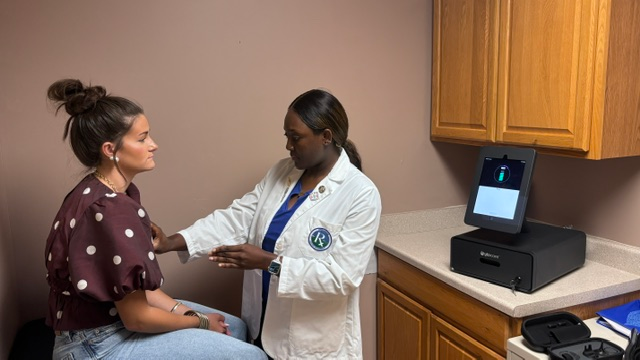
Transportation, provider shortages, and limited broadband remain persistent barriers to access in rural communities. To understand how new approaches are addressing these challenges, the Virginia Telehealth Network spoke with Dr. Shamly Abdelfattah of the Appalachian College of Pharmacy, who is helping lead a partnership with Food City pharmacies and UVA Health to bring pharmacy-based telehealth clinics to the region.
A New Access Point for Care
Increasing access to care, offering more convenient care options, and eliminating long‑standing barriers are central goals of the hybrid clinic model.
Dr. Shamly Abdelfattah, Assistant Dean of Health Innovations and Collaborative Practice at the Appalachian College of Pharmacy, has spent more than a decade designing telehealth solutions for rural patients. His team’s latest innovation places virtual care units directly inside Food City pharmacies, a neighborhood pharmacy located in grocery stores, serving many Appalachian communities where residents routinely shop.
Each hybrid clinic operates with a provider on‑site two days a week for in‑person visits. During the other three days, patients are supported by a medical assistant, pharmacy student, pharmacy technician, care coordinator, or trained telehealth navigator. These team members help patients connect to their primary care provider or in some cases, to UVA Health specialists.
“You have a pharmacy within 5 minutes from where 90% of the population live… and you’re going to be going to the pharmacy at least three to four times every month, compared to three or four times a year for the doctor’s office,” Abdelfattah said.
While telehealth can connect patients from home, residents in rural areas often lack reliable cell service or internet. Pharmacies, however, are accessible, familiar, and already part of patients’ regular routines. This makes them a practical access point for virtual care.
Pharmacists as Care Extenders
Virginia’s statewide test‑and‑treat protocol allows pharmacists to test for flu, strep, and COVID‑19 and initiate treatment. This capability fits seamlessly into the hybrid clinic model. Dr. Abdelfattah notes that this shift mirrors the evolution of pharmacy-based immunizations.
“Twenty years ago, nobody heard about getting a flu shot at the pharmacy. Fast forward, where do you get your flu shot now?” Abdelfattah said.
Pharmacy teams also support chronic care management and remote patient monitoring (RPM). Patients with diabetes or hypertension receive connected devices, and pharmacists help interpret real-time data, reinforce lifestyle changes, and collaborate with physicians on treatment adjustments.
This approach reduces provider burnout, improves chronic disease outcomes, and keeps patients engaged between visits.
Early Outcomes Show Strong Community Impact
Two Viginia Food City locations, in Vansant and Big Stone Gap, currently host fully operational hybrid clinics, with plans to expand. Early metrics show promising results:
- 100+ patients with improved blood pressure or diabetes control.
- 150 telehealth visits completed through the pharmacy-based units.
- 50 test‑and‑treat encounters.
- 80 patients enrolled in RPM programs.
These outcomes demonstrate both clinical value and long-term sustainability. As Dr. Abdelfattah emphasized, the model works only when pharmacies, providers, and community partners buy in, but when they do, access expands dramatically.